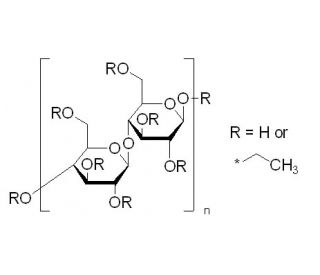
Ethyl Cellulose
CAS NO.: 9004-57-3
Ethyl Cellulose provides excellent functionality in many industrial applications. It offers an attractive range of physical properties and can be blended with other materials to achieve intermediate characteristics.
Technical Specification:
| Item |
K grade |
N grade |
| Ethoxy (WT%) |
45.5-46.8 |
47.5-49.5 |
| Residue on ignition (WT%) |
≤0.40 |
Viscosity (mPa.s)
(5% solution, 20℃) |
4, 5, 7, 10, 20, 50, 70, 100, 150, 200, 300 |
| Loss on drying (%) |
≤3.0 |
| Chloride (%) |
<0.1 |
| Residue on ignition (%) |
≤0.4 |
| Heavy metals (ppm) |
≤20 |
| Lead (ppm) |
≤10 |
| Arsenic (ppm) |
≤3 |
Applications:
| Conductive pastes |
Printing inks |
| Hot melts |
Adhesives |
| Paper coatings |
Fluorescent lighting |
| Waterproofing coatings |
Varnishes |
Organic solvent method of solubility and dissolution:
EC can be dissolved in various organic solvents, such as fatty acid (ethanol, isopropyl alcohol), other alcohols, ketones, aromatic and so on. Common solvent (volume ratio):
1)Toluene :Ethanol = 4:1
2)Ethanol
3)Acetone :Isopropanol = 65:35
4)Toluene :Isopropanol = 4:1
5)Methyl Acetate :Methanol = 85:15
Alcohols and aromatics in the viscosity of the mixture, with alcohol content higher and lower, when alcohol accounts for 30-35%, the lowest viscosity of the composition. Dissolution method: the EC under the stirring slowly add the container filled with a solvent until complete wetting dissolved.
Package:
20kg bag or 12.5kg fibre drum. |